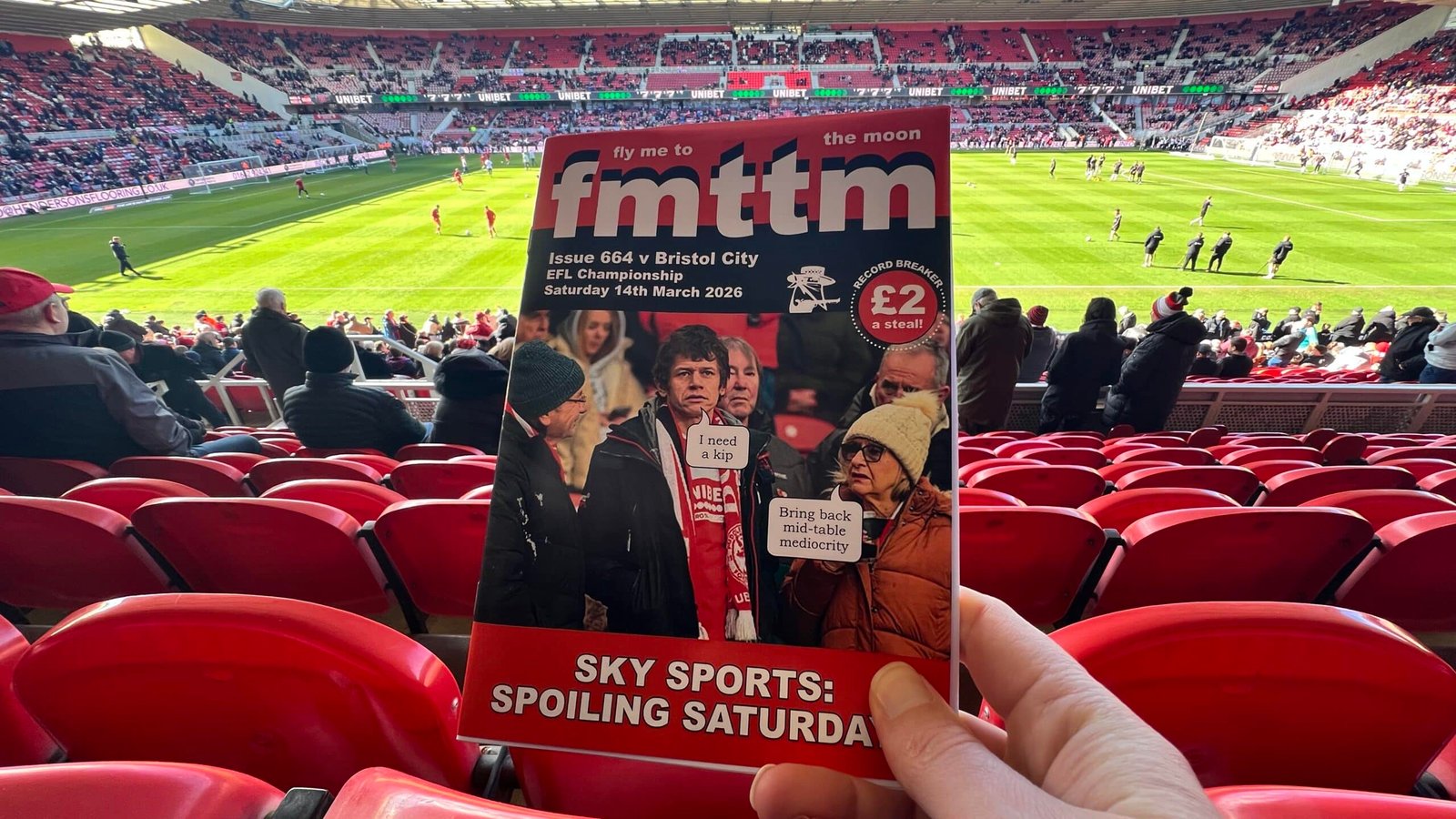
Alan Deamer meets fanzine stalwart Rob Nichols by the Riverside in Middlesbrough
On a matchday outside the Riverside, Rob Nichols once swapped a copy of his fanzine for a night at the theatre.
“Is it cash only?” asked German comedian Henning Wehn, pausing as he walked past. Nichols recognised him immediately – not least because earlier that day he had seen a poster for Wehn’s show at Middlesbrough Town Hall. There was no card machine, so he handed over a copy of Fly Me To The Moon anyway. “Have one on me and have a good gig!”
“You can be my guest tonight,” came the reply. “I think that’s a fair exchange.”
Nichols’ name was on the door that evening. Middlesbrough won, Wehn got his first taste of the Riverside and somewhere in the exchange, a stapled bundle of paper did what it has always done – connect people.
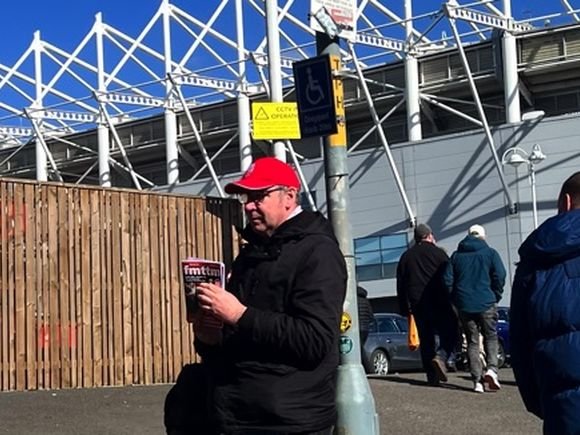
Fly Me To The Moon, first published in 1988 and stewarded by Rob Nichols since 1993, belongs to a tradition that once defined English football culture – supporters printing their own voices, humour and frustrations. Last season, it passed the 600-issue mark, becoming one of the UK’s longest-running football fanzines and overtaking Stoke City’s The Oatcake in total editions.
It did so with little fuss, an almost absurd level of longevity in a game that rarely stands still. With issue 666 on the horizon, there is talk of the devil, though for Boro fans, football hell could well be reserved for the play-offs.
There are still dozens of fanzines printed across the country, but their role has shifted. “In an age when anyone can comment and everyone does on social media, an actual paper publication can seem special again,” says Nichols. “The internet was supposed to be forever, but it feels more fleeting than something you can hold.”
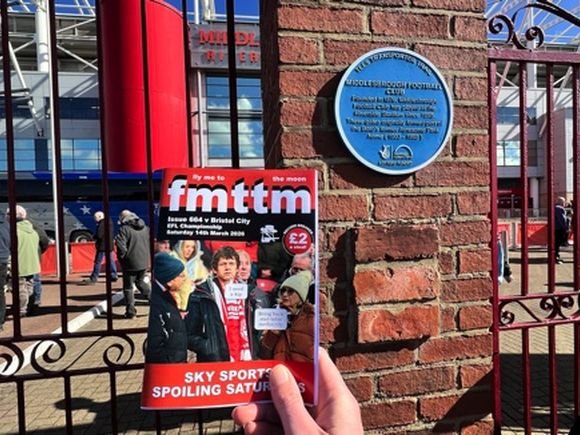
That sense of something tangible has helped sustain the fanzine through moments when it might easily have disappeared. During Covid, supporters subscribed to have copies posted out, contributors kept writing and the monthly rhythm carried on – a small, physical connection to football when the game itself felt distant.
It has also shaped the tone. Unlike many fanzines, Fly Me To The Moon has never been built on outrage. Nichols recalls selling copies outside Turf Moor when a policeman approached and asked which club the fanzine was against. The question lingered. Elsewhere, publications were driven by rivalry and antagonism. Here, the focus remained inward.
“I’m a football optimist,” he says. “If it was all negative, I don’t think I’d still be doing it.”
Instead, the fanzine reflects something broader about Middlesbrough itself – a mix of humour, resilience and creativity. Nichols speaks as much about contributors as readers. Without both, it would not exist. It has come close to folding more than once. Each time, public demand has pulled it back.

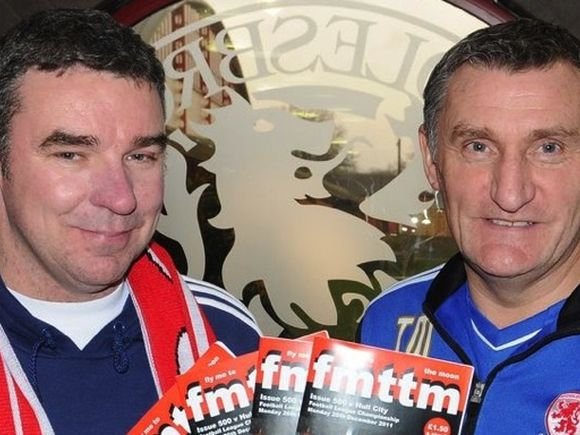
There is history in it, too. The title comes from a line by former manager Bruce Rioch, who once said that if he had to go to the moon, he would want his captain beside him – Tony Mowbray. When Mowbray later returned as manager, it felt like a loop closing. “It was a real thrill,” says Nichols. “Like the mission had almost been accomplished.”
Moments like that linger. Less tangible but equally important are the passing of a fanzine between strangers, the recognition of a name in print, the sense of belonging to something ongoing.
Nichols lives on the site of Ayresome Park, Middlesbrough’s former ground, and speaks about it with something close to reverence. He sometimes guides visitors around the area – pointing out where the penalty spot once was, now marked by a bronze football, or the centre circle, remembered in metal.
Standing there, you can see people drift back into their own memories or into stories passed down to them. Nichols has his own – handing over 50p at the turnstiles, climbing the steps at the Boys End, watching Jack Charlton’s side through the haze of the 1970s. That sense of the past is part of why he talks half seriously about joining an archaeological dig on the site of Ayresome Park.
The idea is far from fanciful. He has already uncovered traces of turnstiles and goalposts at the former ground of Bradford Park Avenue and would like to find remnants of the 1903 footings that heralded almost a century of football at Ayresome Park. Recently, builders in old Middlesbrough unearthed a Victorian time capsule at the former Town Hall. Imagine if a similar discovery could reveal Edwardian memorabilia from the club’s founding fathers – what messages might they have left for the 21st century?
Digging into that once hallowed soil brings the history vividly back – it connects him to the fans, the players and the stories that have shaped Middlesbrough football.
Perhaps that is what Fly Me To The Moon has been doing all along. Not digging into the ground, but into memory. Preserving something physical in a game that has become increasingly abstract. Issue by issue, match by match, it offers supporters something they can still hold on to – a small, stubborn artefact of football culture that refuses to drift away.
And on a Saturday afternoon outside the Riverside, it is still there, changing hands, carrying stories, waiting for the next one to be passed on.