Alan Deamer goes back in time to former GDR Euro hopefuls Stahl Brandenburg
The first thing Ofer Prossner remembers is the heat inside the scoreboard.
“It was incredibly hot in there – almost like being inside a mascot costume.”
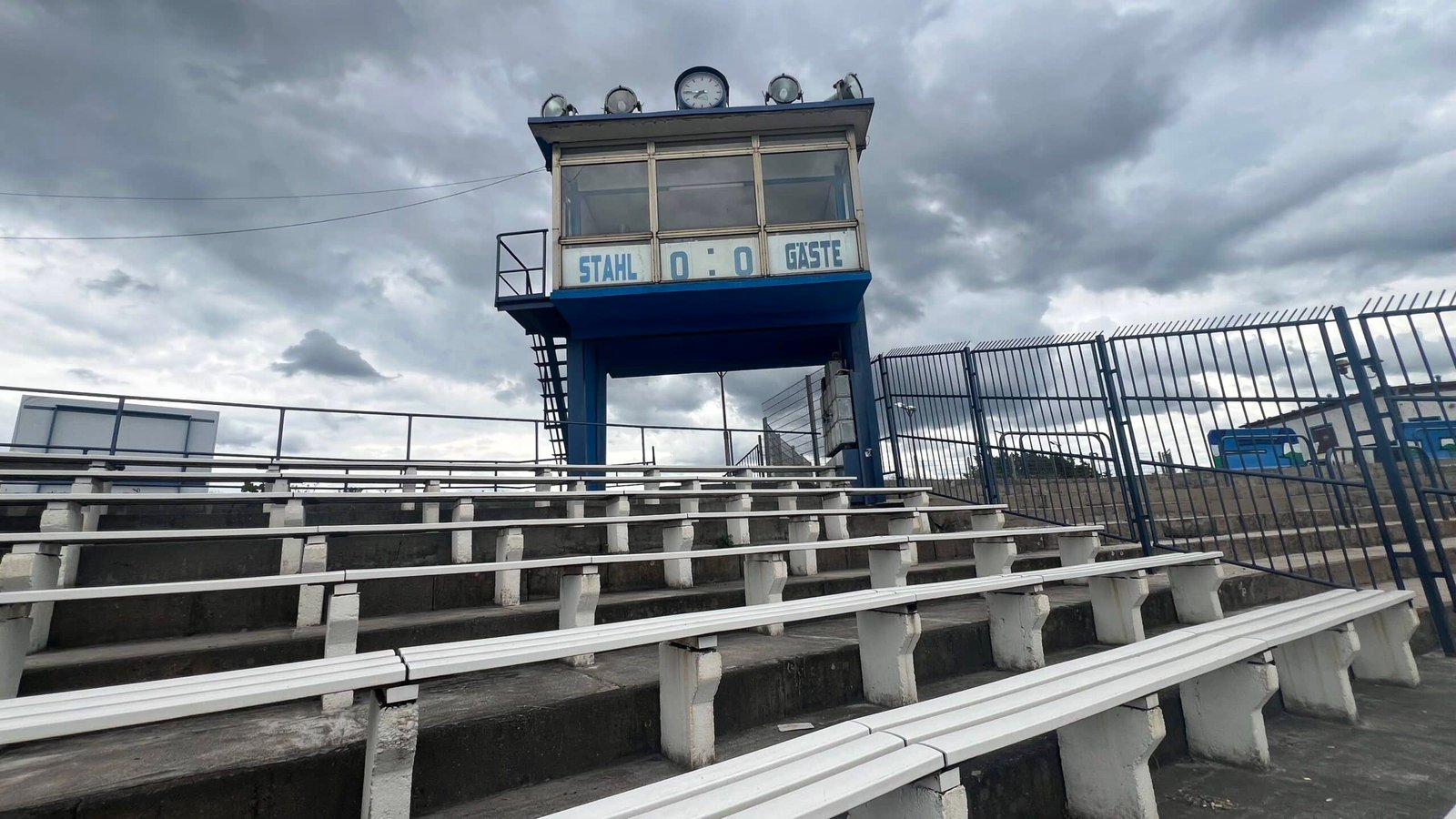
His visit took him inside one of football’s most unusual survivors: the scoreboard at Stadion am Quenz, the home of BSG Stahl Brandenburg. From the terraces, it looks like a relic from another era of football – a reminder of packed crowds, famous victories and the unforgettable European drama of Stahl’s golden era.
But the real fascination lies behind the numbers.
Hidden inside the scoreboard structure is a world of old mechanisms, worn panels and improvised solutions that reveal how much history this simple display has witnessed.
At most football grounds, the scoreboard is something supporters glance at briefly. At Stadion am Quenz, it has become part of the attraction itself.
Modern football is built around speed: instant scores, instant graphics and instant information. Here, there is still a small pause between the goal and the number appearing
Someone still has to make it happen.
And that human touch is exactly why Stadion am Quenz remains worth the journey to Brandenburg an der Havel, 70km west of Berlin.
“It offers quite a view of the ground,” says Prossner, an avid groundhopper. “But inside it also felt like a place where history had just been left sitting there.”
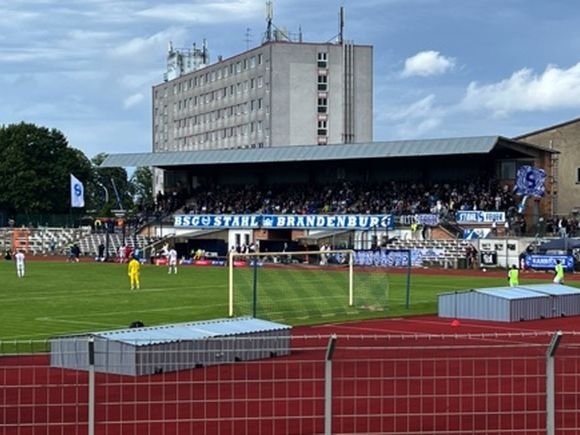
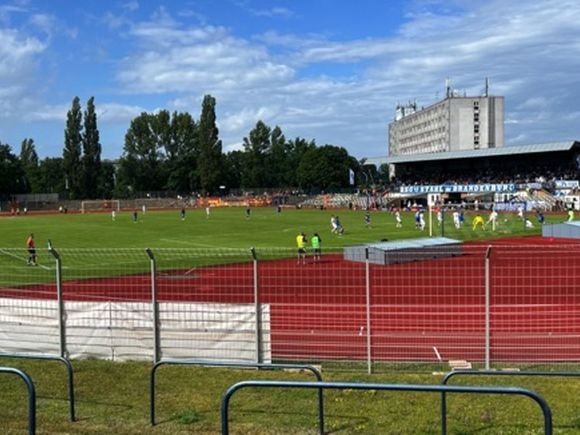
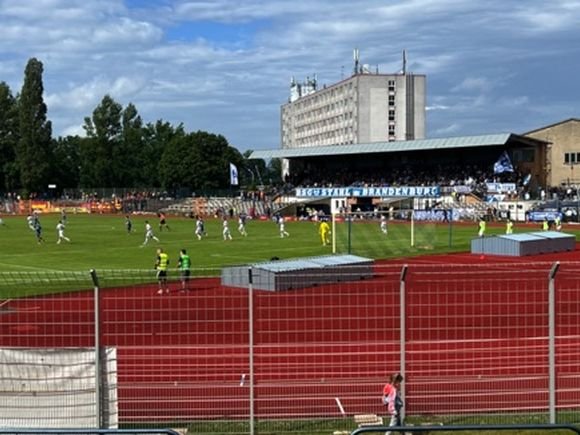
From above, Stadion am Quenz stretches out below. The terraces, running track and pitch offer a reminder of the crowds that once filled this ground. This was a stadium that welcomed European football, where a club from an industrial city in eastern Germany briefly stood among the continent’s competitors.
For many visitors, the scoreboard is now one of the main reasons to make the journey to Stadion am Quenz. At a time when many grounds have replaced their character with modern screens and standardised facilities, this is something increasingly rare: a direct connection to football’s past.
And there is more history to discover.
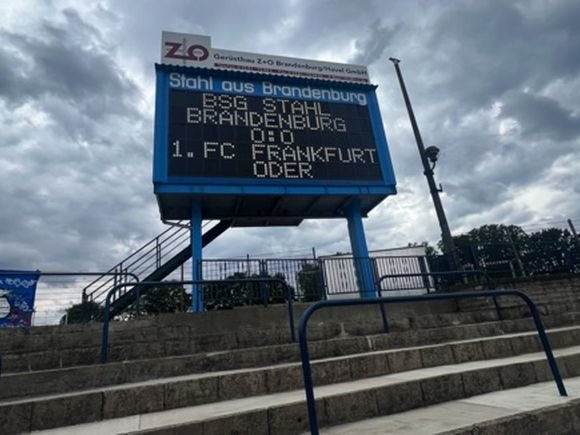
Stadion am Quenz preserves two different generations of scoreboard. Together with the Sprecherturm, they capture two eras of football culture – one shaped by simple craftsmanship, the other by the arrival of electronic displays. Decades later, all three survive for the same reason: people cared enough to keep them alive.
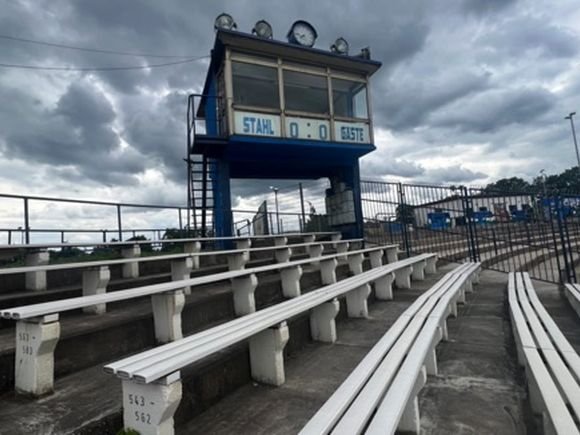
Built in 1971, the distinctive Sprecherturm became the voice of Stadion am Quenz, overlooking the pitch as announcements, music and match-day moments filled the ground.
The older manual scoreboard belongs to the tower, from a time when updating the score was a physical task. Before digital displays and instant graphics, somebody had to climb into position and change the numbers by hand.
Today, thanks to volunteers including the IG Freunde des Stahlstadions, the Sprecherturm remains one of the stadium’s most recognisable features. It has not been preserved simply as a monument. It remains part of the stadium’s identity.
Looking closer at the scoreboards, the details tell their own story.
They are not polished museum pieces. They are objects shaped by use, with every figure carrying the marks of decades of football.
Prossner noticed the worn edges, faded surfaces and evidence of countless hands changing the score. He even found himself wondering whether the number nine had ever actually been used, because it looked just as weathered as the others.
It is a small observation, but it captures the charm of Stadion am Quenz. Here, imperfections are not something to hide. They are proof that something has been part of football life.
The larger electronic scoreboard that dominates the ground tells a different story.
Installed in 1986, it arrived during Stahl Brandenburg’s greatest era. The club had reached the DDR-Oberliga, the stadium had expanded and expectations were higher than ever.
Built by the Brandenburg steelworks between 1952 and 1955, Stadion am Quenz represented the close relationship between industry and sport in East Germany. Stahl Brandenburg was more than a football club; it represented the factory, its workers and the identity of an entire city.
The stadium developed alongside the team, with new terraces, a main stand and the electronic scoreboard reflecting the club’s growing ambitions.
In 1986-87, Stahl Brandenburg reached the UEFA Cup. After overcoming Coleraine, the club faced IFK Göteborg, who would go on to win the competition.
The Swedish side won 2-0 in Gothenburg, but 18,000 supporters packed into Stadion am Quenz for the return leg as Stahl fought for one of the biggest results in the club’s history. The 1-1 draw was not enough to prevent elimination, but it remains one of the defining occasions at the ground. A few months later, Göteborg lifted the UEFA Cup by defeating Dundee United in the final.
The scoreboard recorded every goal of the Second Round tie here. Ironically, it did so without floodlights. The famous UEFA Cup matches were played during the day because the stadium’s lighting system had not yet been completed. The European nights at Stadion am Quenz were actually European afternoons.
The floodlights wouldn’t arrive until 1996, by which time Stahl were in the fifth-tier of the all-German league set-up.
After German Reunification, the steelworks withdrew its support and Stahl Brandenburg’s fortunes declined. The huge crowds disappeared and the floodlights, another symbol of the club’s ambitions, were eventually removed in 2017.
The scoreboard survived. But the technology inside it did not.
When the original electronics failed, supporters refused to simply replace it with a modern LED screen. Instead, they found a solution that perfectly reflects the character of Stahl Brandenburg.
The display was rebuilt using polystyrene panels, each painted black and finished with warm white dots to recreate the glow of the original illuminated bulbs.
From a distance, the illusion remains convincing. The figures appear to glow as they did during Stahl’s greatest years. Only closer inspection reveals the secret: the display is not powered by advanced technology, but recreated by hand using simple materials.
The scoreboard survives not because of expensive technology, but because supporters found a way to keep an old idea alive.
That same spirit runs throughout Stadion am Quenz. Volunteers restore terraces, maintain structures and protect the details that make this place unique.
The Sprecherturm still overlooks the pitch. The numbers still change. The voice of the stadium still exists. And one month from now, Stahl Brandenburg will take on Ludwigfelder FC at the start of yet another campaign in the Brandenburg-Liga in level 6 of the German league pyramid.