Malta's former national stadium has been left to rot since its last game in 1981
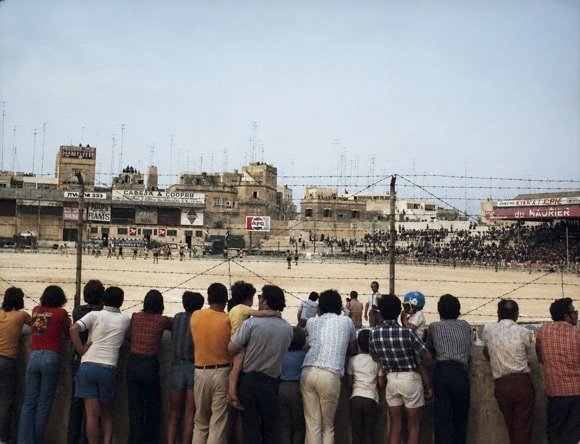
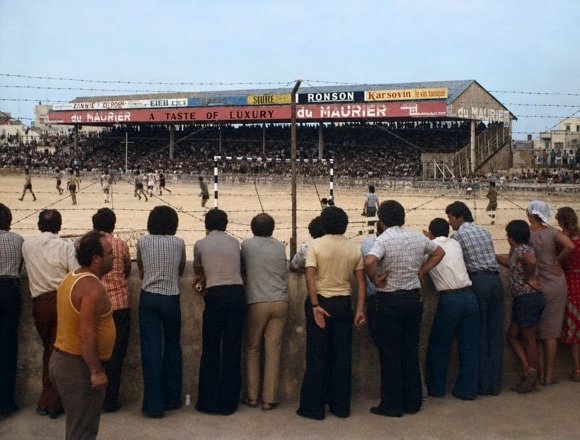
Fans of a certain age will remember a game between Malta and England in 1971. The result and scorers have been buried in most people’s memory banks but what remains is a vision of pitch of compacted sand overshadowed by spectators hanging from every roof and bookended by black-and-white stripy goalposts. It felt like they were holding a European Championship qualifying game by a desert oasis.
Think of Maltese football, and you think of Gżira, aka the Empire Stadium, whose very name has echoes of the pre-war era that spawned it. It was built on land owned by nobleman Pietro Paolo Testaferrata Moroni Viani, an illustrious dynasty partly descended from the Knights of the Holy Roman Empire. After the death of his father, Baron Salvatore, in 1911, this first-born son had inherited this plot in unpromising surroundings.
In 1919, a leading light of another prominent clan, football-loving Carmelo Scicluna, married Pietro Paolo’s sister, Elvira. Scicluna was already in charge of Malta’s first real football stadium, the Mile End Sports Ground, opened in 1912 across from today’s Victor Tedesco Stadium, home of Hamrun Spartans.
A passionate follower of the game in Malta, in 1922 Scicluna arranged a 40-year lease with his brother-in-law to develop a football ground on this plot in Gżira, then considered a suburb of Sliema. It was unveiled that November as the Empire Sports Ground. A Malta Select XI played the crew of the HMS Ajax, relaxing after seeing out the end of the Greco-Turkish War a short sail away. But Scicluna knew that Maltese football needed to develop beyond its role as a backwater used by the British military for entertainment.
As the game flourished in Central Europe, he invited top clubs from Vienna, Prague and Budapest to play here in the winter holidays, brightening up the domestic season of the same six to eight teams competing every year in the Malta First Division. Players and fans observed and admired the fresh approach and tactics, a growing local appetite for the game convincing Scicluna to knock down the old ground and construct a new, modern one, the Empire Stadium, in 1933.
Here, Scicluna would also put on greyhound racing, boxing matches and circuses, while continuing to bring over prestigious football teams from Britain and mainland Europe. Heavily bombed by German and Italian forces in World War II, Malta held out, famously earning the island the George Cross for its bravery. Scicluna himself was awarded an OBE for his role in developing sport in Malta and helping the country recover.
The Testaferratas and Sciclunas were further tied by the marriage of another of Pietro Paolo’s sisters, Maria Violet, Baroness of Tabria, with Marquess John Scicluna in 1921. In the early 1950s, the two protagonists of the original Gżira land deal of 1922 passed away, football-loving Carmelo Scicluna in 1952 and, two years later, without leaving a will, Baron Testaferrata himself, survived by his four children.
Meanwhile, as the post-war European game began to take shape, Malta played their first international in Gżira in 1957, a 3-2 defeat by Austria. Once the European club competitions started up, Maltese teams welcomed the likes of Alf Ramsey’s Ipswich, Dukla Prague and the Manchester United of Law, Best and Charlton.
The short film of that day looks very much like the England visit of four years later, elite players struggling to control the ball on sand, an old-school grandstand sporting brand names of long-lost ales and sherries, and a crowd three times bigger than the stadium’s official capacity of 10,000. And, of course, those stripy goalposts. The match ended up goalless, the conditions barely conducive to swift passing football.
With the lease having run out on the Gżira plot in 1962, its ownership seems to have passed back to the original dynasty, given that the Scicluna Cup held here was now called the Testaferrata Cup. With money now to be made from gate revenue and the lucrative visits of foreign sides, the Maltese FA was also keen on getting in on the act. And for all its golden heritage, Gżira, sandy pitch and all, belonged to a bygone era.
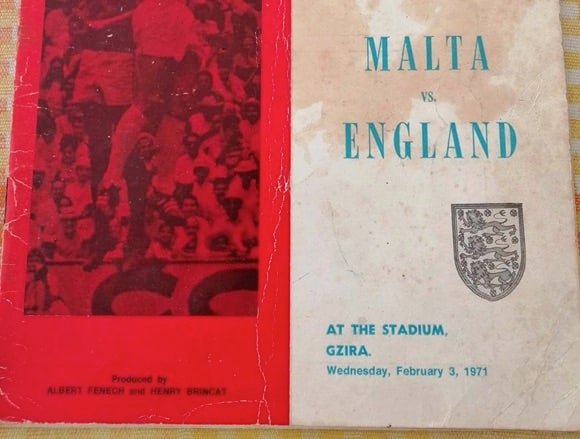
The whole island seemed to be in the stadium for the visit of England, only recently dethroned world champions, on February 3, 1971. People started heading to Gżira – halfway between Sliema and Valletta – from the morning onwards. By noon, according to witnesses, it was already packed. The game kicked off at 3pm, locals brooding over derogatory remarks in the UK press about the state of the stadium and suitability of the Malta side to compete at this level.
Hurling insults and fruit at England mascot Ken Baily in the pre-match warm-up, they provided an intimidating atmosphere for the visitors, who included three World Cup winners from 1966 among their number. No wonder, then, that the Maltese refer to this at the ‘Match of the Century’.
Holding off their illustrious visitors for much of the first half, Malta succumbed to a Martin Peters’ strike on 35 minutes in what was to prove the only goal of the game. The hosts nearly equalised later when ex-QPR striker Joe Cini was one-on-one with Gordon Banks but failed to convert.
A defeat then but, in the greater scheme of things, also a victory. Now involved in the regular merry-go-round of qualifying campaigns – 1971 had only been Malta’s second participation, having played Denmark home-and-away in 1962 – the Maltese would keep the likes of Wales, West Germany, Hungary and Sweden to narrow-margin wins at Gżira throughout the decade.
Behind the scenes, a rift between the government and the Malta Football Association saw games moved out of The Stadium (as the ground was now officially referred to) and plans put in motion to build a new national stadium at Ta’Qali.
A former military airfield in the middle of nowhere west of Valletta, Ta’Qali is now home to convention centre, a national park, a crafts village and an aviation museum. The new national stadium opened here in 1981. Along with the smaller Centenary Stadium next door, it has hosted the national side, the cup final and most Maltese Premier League games ever since.
Gżira held its last match, a league game, in November 1981, the season when most fixtures were switched to Ta’Qali.
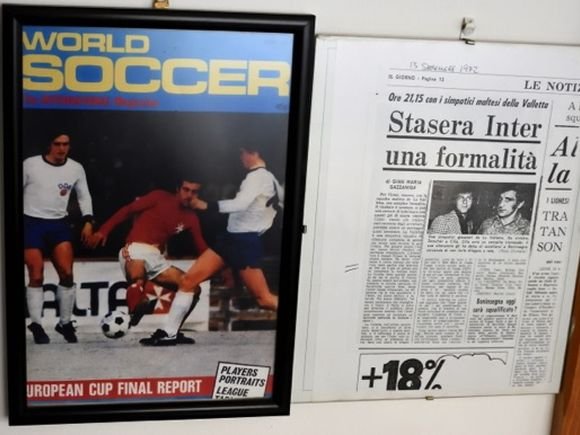
Gżira had already fallen foul of the authorities when fans had pelted officials with stones and missiles late in a game against Poland in December 1980, fruit no longer up to the job, it seems. The match abandoned, Malta were forced to play home ties abroad, though the decision took long enough for the Maltese to stage one final international at The Stadium, against East Germany, in April 1981.
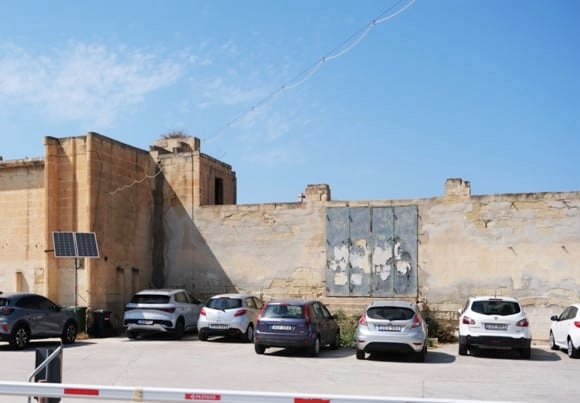
For nearly half a century, Gżira has been left to the elements, neglected and overgrown – but that’s not the end of the story. While all around it, apartment blocks replaced the tatty houses as centrally located Gżira gentrified, the site close to the University of Malta became an extremely valuable piece of real estate.
As the four descendants of Baron Testaferrata, born between the wars, began to themselves die out, the issue of ownership of the abandoned plot entered the public sphere. Malta, a member of the EU since 2004 and Schengen since 2007, had seen its economy grow substantially, and with it, the price of real estate.
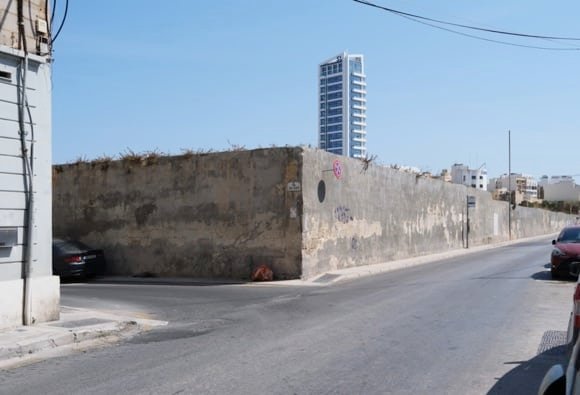
Baron Testaferrata had left behind several properties and estates, their value now running into the hundreds of millions of euros. Before his death, parts of his estate had been assigned to the four descendants, but without certain legal paperwork. Now their children, the baron’s grandchildren, related as cousins, were disputing who owned what. Among the holdings was, and is, the former Empire Stadium at Gżira.
In a case that has dragged on for well over a decade, courts have been mulling over the legal status of the baron’s first-born inheriting the lion’s share of the estate. During this time, the high walls around the former ground prevent curious football travellers from peering in and seeing where the Match of the Century took place in 1971.
As for the Sciclunas, many of whom poured fortunes into the arts, sport and beautiful palaces, the casual visitor can gauge something of their opulent lifestyle by taking tea or enjoying a luxurious meal at the Palazzo Parisio, a popular wedding venue in Naxxar, west of Sliema. Football pioneer Carmelo Scicluna, Memé to his many friends, is not forgotten either, a small memorial standing in the square named after him, Pjazza Meme Scicluna, not 500 metres from the stadium ruins.