A fan’s guide – the club from early doors to today
Leaping from the National League to the Championship in just three seasons, Wrexham AFC have gone from a Hollywood fairy tale to a serious proposition intent on reaching the Premier League well before the decade is out.
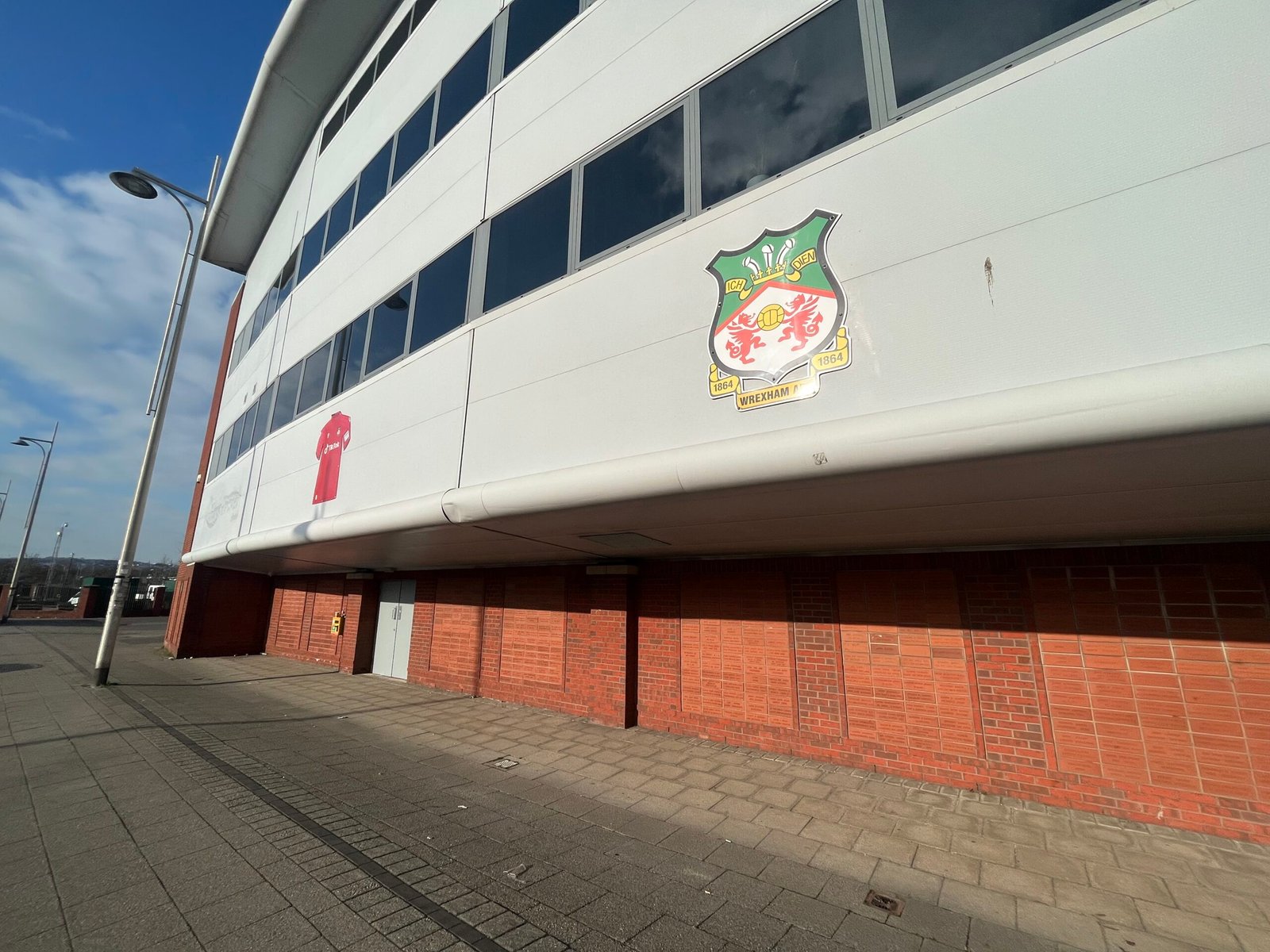
By that time, capacity at the venerable Racecourse Ground, the oldest still-active international stadium in the game, will have increased to 18,500 after the opening of the Kop Stand, the rebuilt home end due to be unveiled by early 2027.
America’s venerable Sports Illustrated magazine ran a major article with the initial news of the construction in 2025 – albeit on the same webpage as explaining what the Championship was and the mathematics of Wrexham reaching it.
Ever since the 2021 purchase of the club by film stars Ryan Reynolds and Rob McElhenney from the supporters who had saved it a decade earlier, this unlikely adventure set in a neglected corner of north Wales has piqued interest across the Atlantic.
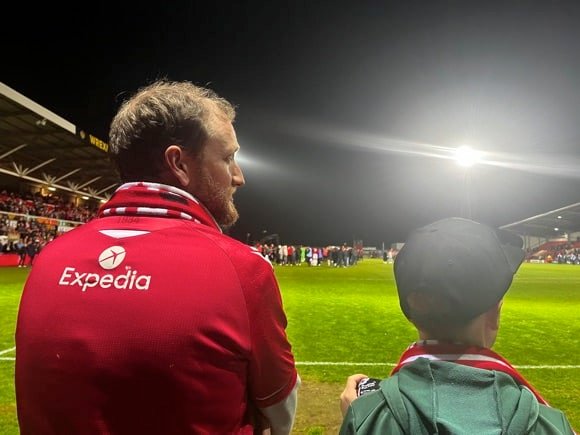
First there was the WTF factor, the incongruity of seeing the pair, red-and-white scarves dangling from their necks, watching fifth-tier football at a ground that hadn’t staged a Football League game since 2008. Then there was the curiosity value, the occasional celebrity enjoying a pint at the equally historic Turf Hotel, where the world’s third oldest professional football club had been formed in 1864.
Then Wrexham, as if by osmosis, joined the elite. In July 2022, having just missed out on promotion after Reynolds and McElhenney’s first full campaign in charge, the Red Dragons played their first pre-season friendly at Nantwich in front of 1,400 people. Almost exactly a year later, Wrexham’s first warm-up fixture was against Chelsea in front of 50,000 in North Carolina.
The hit docu-series Welcome to Wrexham would drop a month later. Award-winning and lucrative to the tune of $500,000-plus per episode, it segued into its fourth season in 2025. A year after the first North American tour, shortly after promotion to League One, came the news that anyone flying premium on United Airlines would receive Wrexham-branded pyjamas.
That same month of July 2024, the Red Dragons not only played Chelsea again but held the recent Champions League winners to a draw in the heart of Silicon Valley.
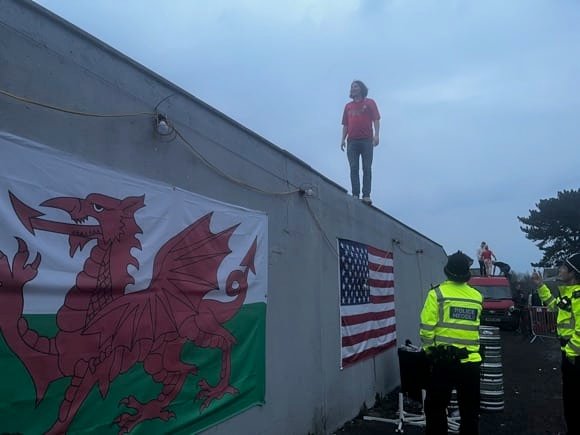
No wonder, then, that Sports Illustrated covers this little-rewarded soccer team (main honours: Third Division North 1978, FA Trophy 2013) the same as it follows the gilded fortunes of NFL, NBA and MLB champions. As and when Wrexham rub shoulders with the American-owned grandees of the Premier League, the Arsenals and the Manchester Uniteds, the club’s global profile will be in a similar bracket.
It would also be the first time that Wrexham have featured in England’s top flight, the next best being four brief and mediocre seasons in the former Second Division between 1978 and 1982.
For all the hype surrounding this feel-good Hollywood saga, it could be forgotten that Wrexham were chosen for the role precisely because the potential owners needed to lend a helping hand to a club fallen on hard times. Humphrey Ker, the limey in Rob McElhenney’s writing pool, had been given a mission by his boss to find a team down on its luck but full of character, potential and, most of all, core local support.
The English comedian, who had appeared in the hit series created by McElhenney about his home town, It’s Always Sunny in Philadelphia, had taken to watching Liverpool’s progress in the Champions League over lunch in LA. During one fateful game, the dramatic semi-final win over Barcelona in May 2019, the Brit’s usually calm demeanour matched the mayhem of Anfield 5,000 miles away.
One binge-watch of the fly-on-the-wall series Sunderland ’Til I Die later, and the penny dropped for the intrigued American celebrity. This wasn’t just Anfield, Messi and glory in prestigious sporting arenas. There was despair, relegation and gritty wins at Bury. This was people’s lives, week in, week out, and McElhenney and his newly found convert companion, Ryan Reynolds, wanted in.
A large part of Wrexham’s attraction was its longevity. No other professional club, in fact, has been based at the same stadium for so long. It was more than 160 years ago that members of Wrexham Cricket Club met at the Turf Hotel to agree upon a sport to play in the winter.
Shortly afterwards, in October 1864, they were taking on the local fire brigade in game that involved a ball being kicked. Association football was barely in its infancy: it hadn’t been a year since Ebenezer Morley drafted its very first rules. The FA Cup wouldn’t come along for another seven years, the Football League, nearly a quarter of a century.
The cradle of the Welsh game, Wrexham favoured the round-ball game over the oval one prominent in the south. As two main teams emerged – Wrexham and Druids FC from nearby Ruabon – a first Welsh national XI and FA were created here in 1876.
Players were mainly drawn from Druids and Wrexham, who also contested the first Welsh Cup final at Acton Park north of town two years later. In between, the Racecourse Ground hosted Wales’ first home international, also against Scotland, Druids and Wrexham again providing the bulk of the team.
Following Druids’ lead, inaugural Welsh Cup winners Wrexham took part in the English FA Cup in 1883, although were to face familiar rivals Oswestry at the Racecourse Ground in a 4-3 defeat. It was only after World War I, however, when Wrexham joined the Football League, that participation in the FA Cup became an annual undertaking.
The creation of the Third Division North in 1921 allowed Wrexham to take on long-established professional sides as far afield as Ashington and Durham on week-by-week basis. Before 1914, Wrexham had competed with teams from the Midlands and North-West in The Combination league, winning four titles in the early 1900s, then faced the reserve sides of Aston Villa, Wolves and WBA in the Birmingham & District League.
Once installed in the Third Division North, Wrexham found their feet by the 1930s, ditching their previous colours of blue, then green, and establishing a new identity in red. A record league attendance for the Racecourse Ground was set on Boxing Day, 1936, 29,261 watching the cross-border derby with eternal rivals, Chester City.
An effective full-back, Neal had worked on the coaching staff with his predecessor, hard man Alvan Williams, at Southend, and the Welshman duly brought the former Villa defender with him when he returned to the Racecourse Ground in 1966.
A fearsome No.9 who had made his playing debut for the Red Dragons at a fiery cross-border derby with Chester ten years earlier, Williams expected total commitment from all around him. When he sensed less than 100% support from the club board, he walked out on Wrexham and football altogether, to run pubs across North Wales and beyond. As well as an untried John Neal, Williams left in place the makings of an academy, whose graduates would serve Wrexham well in the decade to follow.
Gaining promotion from the Fourth Division in 1970, Neal’s team soon rose to the upper echelons of the Third and, crucially, lifted the Welsh Cup in 1972. Since 1961, the winners had been granted a passage to Europe to play in the Cup Winners’ Cup, allowing Neal’s Wrexham to take on FC Zürich and hold the recent Swiss champions to a draw. In the first of several memorable European nights at the Racecourse Ground, FCZ crumbled under Wrexham pressure and the roar of 18,000 voices to give away a 1-0 lead and succumb to a 2-1 defeat.
Just turned 18, starting at No.11 having made his debut a year earlier, was Mickey Thomas. Say the word ‘Wrexham’ to any football fan of a certain age, and they’re bound to come back with two words by way of instant association: ‘Mickey Thomas’. Born in nearby Mochdre, as a tricky young winger Thomas was integral to many of Wrexham’s successes in the 1970s, helping Neal’s team win the Third Division in 1978 before heading to Manchester United.
While Wrexham would struggle in the Second Division for four tough seasons – the highest-ever league position in the club’s history until 2026 – they would continue to cause upsets in Europe.
Few sides relished a visit to the Racecourse Ground, passionate supporters crowded over the touchline – not Stockholm’s venerable Djurgården who lost there in 1975, nor Belgium’s record champions Anderlecht who drew there in 1976, and certainly not Yugoslavia’s Rijeka who lost there in 1978. Soon-to-be European Cup winners Porto were put to the sword in 1984.
After spells at Everton, under John Neal at Chelsea and at indoor soccer team Wichita Wings, Thomas ended his playing career where it started. At 37, he captained the Red Dragons to their greatest victory, a 2-1 win over Arsenal in the FA Cup in January 1992. His club had finished 92nd of The 92 eight months before, but had been spared a first-time exit from the Football League due to its expansion the following season.
Arsenal had reached the very opposite end of the league pyramid, winning a second title in three years. Few in the Racecourse Ground that day believed that Wrexham could beat them – Mickey Thomas was one of them. Spanking a late free-kick from outside the box into the top corner, the former Welsh international levelled the score at 1-1.
Two minutes later, young Steve Watkin put the hosts ahead, the crowd pouring onto the pitch at the final whistle. Wrexham’s victory sits alongside Hereford and Colchester as one of the greatest upsets in the tournament’s history.
When Humphrey Ker was casting around in his football memory for a footballing fairy tale, that Mickey Thomas goal appeared. It prompted the question, as it once did to everyone unaware of the club’s demise, of wondering whither Wrexham?
Whither, indeed. After two straight relegations, Wrexham wallowed in the fourth tier for a decade, before the arrival of Leeds and Wales legend Brian Flynn. Seeing out his playing career at the Racecourse Ground, Flynn steered Wrexham to that legendary cup win over Arsenal, a draw at West Ham in the next round and a win over the same opposition five years later. That same season, the finishing touches were being added to a top-quality new training ground, Colliers Park.
Missing out on a play-off place for the second tier on goal difference under Flynn in 1998, Wrexham fans had every reason to believe that the new century would prove as promising as the last decades of the last.
With Flynn snapped up by Swansea, and without a back door to Europe after dropping out of the Welsh Cup in 1995, Wrexham had been kept afloat by local entrepreneur and life-long fan Pryce Griffiths. Bowing out due to ill health in 2002, he sold his majority share to Alex Hamilton and Mark Guterman, who assumed the chairman’s role he had fulfilled, with mixed success, at bitter rivals Chester City.
Having taken over the lease of the land on which the Racecourse Ground stands, the pair quickly earned fans’ ire, not least when Hamilton set about selling the site and finding a new ground. As the pair engaged in legal disputes between themselves, it emerged that Hamilton had allowed the club’s debts to accumulate unchecked – not least to the taxman.
Wrexham were duly placed under administration in 2004, deducted a then-record ten points and effectively forced from mid-table safety. Despite a late rally, and a memorable afternoon at Cardiff’s Millennium Stadium to win the Football League Trophy, the fourth tier beckoned.
While Hamilton fought to win back freehold ownership of the stadium in various courts of appeal, a former director and local car dealer, Neville Dickens, buoyed by the support and fund-raising of long-suffering fans, assumed control of the club and reached agreement with administrators.
Maintaining league status on the last day of the 2006-07 campaign with a nail-biting victory that condemned to Boston United to non-league football, Wrexham suffered that same fate a year later at promotion-seeking Hereford. Wrexham’s 87-year stay in the Football League had come to an end.
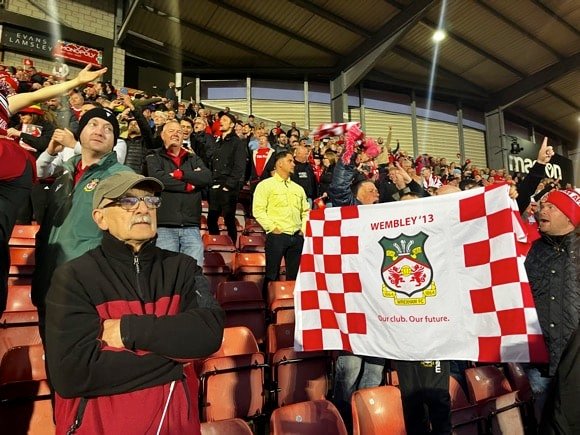
It would take 15 years and the unlikely arrival of two Hollywood stars for Wrexham to regain membership of The 92. It even required three seasons for the Red Dragons to make the play-offs, first a thrashing by Luton in 2011, then a narrower defeat at the same hands a year later. Then making the Conference play-off final in 2013, an all-Welsh affair, Wrexham were felled by two very late goals from Newport.
Redemption would not come for another decade.
Bizarrely, having never played at Wembley in nearly 150 years, Wrexham were making their second appearance in five weeks, having beaten Grimsby on penalties to lift the FA Trophy the previous March.
The revenue from these two marquee fixtures, each attracting crowds of 30,000-plus, would prove just reward for the Wrexham Supporters’ Trust, whose communal £250,000 had seen off an ownership bid from transsexual hotelier and reality TV star Stephanie Booth in 2011.
Ironically, around the time Wrexham first blipped on the radar of Ryan Reynolds and Rob McElhenney, the club had not long closed the door on the worst season in its long, long history, mercifully terminated by the pandemic shutdown in the early spring of 2020. But for seemingly random calculations of fractions of points per game, Wrexham may well have tumbled down to the sixth tier that season.
Later that summer, before the start of the delayed new campaign, negotiations between the celebrity duo and the Wrexham Supporters’ Trust shifted from incredulity to practicality, all bound by non-disclosure agreements to keep matters secret until that September. Officially agreeing the takeover in November, the day before a hard-fought win at Hartlepool, the WST relinquished control the following February.
Despite plentiful press and preparations for major docu-series on FX, the season ended on a flat note, one point from the play-offs – although Notts County’s decisive 1-0 win at the Racecourse Ground did hint at a gripping plot line of see-saw rivalry.
Real drama would ensue the following season, as the film crew fixed their lenses on team, staff and fans, the ownership put their faith in former Sunderland boss Phil Parkinson, and improbably prolific striker Paul Mullin arrived from Cambridge. All the elements were in place for one of the game’s great rollercoaster rides.
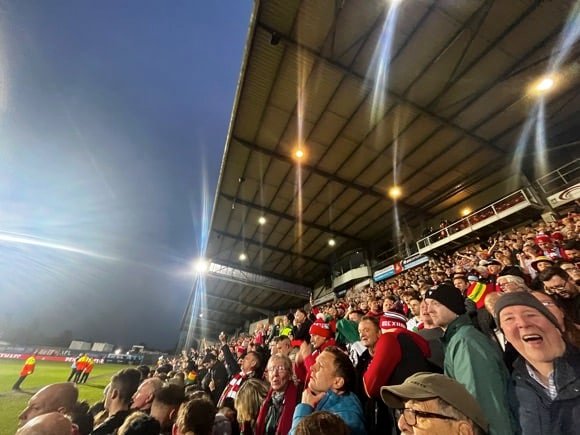
It began somewhat prosaically at Maidenhead that October – an early red card for the visitors, another Mullin goal and a 3-2 defeat in what was the new owners’ first appearance. Four days later, nearly 10,000 crammed into the Racecourse Ground for the visit of Torquay – and Ryan and Rob in the stadium.
After another crucial defeat by Notts County – a red card nine minutes in, a missed Mullin penalty – the owners invested a club record £300,000 in striker Ollie Palmer, who scored the only goal on his debut. His brace and two further goals in stoppage time then allowed the Dragons to reverse relegated Dover’s 5-2 lead at the Racecourse Ground and win 6-5 in a game for the ages, before two blockbuster clashes to round out the season.
The first occurred in the FA Trophy, league leaders Stockport the visitors to the Racecourse Ground and a visit to Wembley at stake. With the one-leg semi pegged at 0-0, two cheeky chips from Paul Mullin in stoppage time sent the crowd wild, an emotional Ryan Reynolds included.
He was in a more sober frame of mind for the final, a tense affair settled by one Bromley goal, the cameras equally focused on fellow Hollywood icon Will Ferrell, McElhenney and David Beckham in the posh seats.
Blockbuster 2 came six days later. A second-placed finish in the National League had granted Wrexham passage to the semi-final of the play-offs with home advantage. All seemed well once top league scorer Mullin put the hosts ahead with a penalty but visitors Grimsby hit back immediately, setting a ding-dong pattern for the game.
Six goals later, the last two within two minutes of each other, extra-time led to last-gasp missed chances and a winning header from Grimsby’s Luke Waterfall with penalties a matter of seconds away. If Wrexham’s incoming owners needed a lesson in football heartbreak, this was it.
Nearly a year and another three dozen Mullin goals later, the drama was off the scale. Neck and neck on 100 points, a guaranteed return to the promised land of the Football League at stake, two of the three oldest professional clubs in the history of the game have been going at each other hammer and tongs for 95 minutes at the Racecourse Ground. It’s Easter Monday, 2023, and, after 15 years in the non-league wilderness, revival would almost be too apt a word to describe the transformation of Wrexham AFC – once referee Scott Tallis blows for full-time.
The Dragons have just come from behind to lead 2-1, then 3-2, against their National League nemesis, Notts County. With four games to go until season’s end, but only three for the visitors, three points here would put enough daylight between Wrexham and purgatory.
But the final whistle doesn’t come. On the contrary, as a Notts County ball floats over the fatal rectangle, Tallis spots a stray Wrexham arm brushing against it. Penalty! Few refs would have been brave enough to give it, here on 95 minutes at the pressure cooker that is the Racecourse Ground, with the home club’s future on the line. Tallis is one of them.
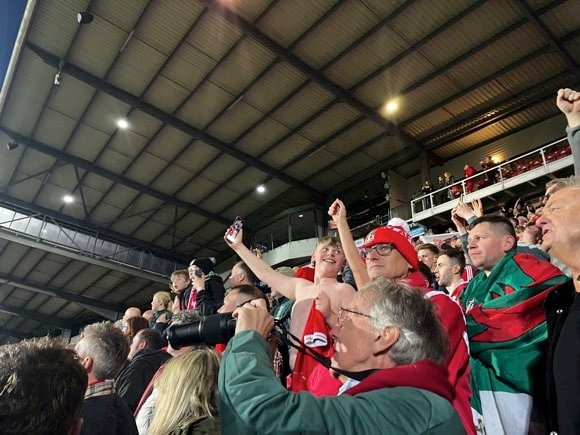
Persuaded out of retirement two weeks before by his former club, ex-England keeper Ben Foster faces the spot-kick. Sensing from the angle that Notts County’s Cedwyn Scott has placed the ball before his run-up, he dives to his right. A strong arm in lime green bats the ball away as the Racecourse simply explodes.
Up in the suitably modest VIP box, Wrexham owners Reynolds and McElhenney have totally lost it. Drama, pressure, passion, these are the stock in trade of these Hollywood actors, scriptwriters and producers. This was simply a different level. A hoarse Reynolds will soon run over to kiss Foster full on the lips, promotion and redemption now in reach. If any one minute encapsulates the pure madness that has been the Wrexham adventure since Rob and Ryan rode into town, it’s this one.
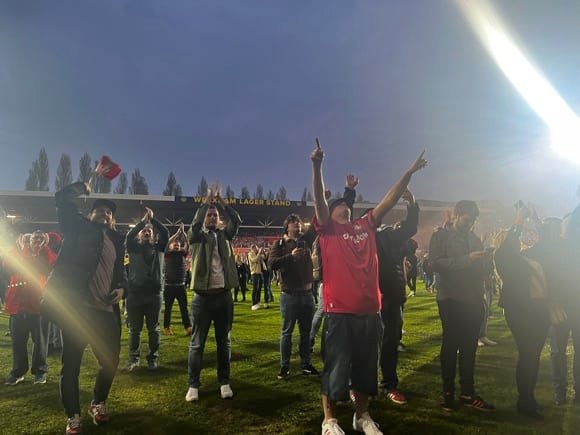
Hours before, the mayor had awarded the celebrity duo the Freedom of the City, Reynolds expressing his gratitude to the people of Wrexham in a humble and heartfelt speech. It wasn’t the talk of some asset-stripping tycoon, whose capricious transfers have undermined the coach and unbalanced the team. It was recognition that this has been a two-way process, that what Wrexham has given the club’s incoming owners has more than compensated for the millions they have found – and generated – to revive it. Trust, respect and loyalty are not so easily found in Hollywood, let alone earned.
Ten days after getting over the line with a 3-1 win over Boreham Wood – despite conceding a goal a minute after kick-off – the team, staff, cast, crew and owners are riding an open-top bus through Wrexham in promotion celebrations. Yes, 15 years after the Dragons breathed their last in the Football League, it is the perfect Hollywood ending, but it took the Hand of Fos, heartbreaking defeats and hatfuls of goals from Paul Mullin to get here.
Picking up Northern Ireland winger James McClean and former Scotland and Sunderland veteran Steven Fletcher to guarantee a few late goals off the bench, Wrexham set about League Two in the same rollercoaster fashion as before, losing 5-3 to MK Dons and holding Swindon to a 5-5 draw. A 5-0 defeat to old foes Stockport County acted as a wake-up call to Phil Parkinson’s men, who then strung three unbeaten runs together to romp home to a second promotion on the bounce.
The Racecourse Ground was in full party mode for the 6-0 trouncing of Forest Green that sealed the deal, the familiar pinpoint crossing of James McClean and deadly finishing of Paul Mullin putting the outcome beyond doubt.
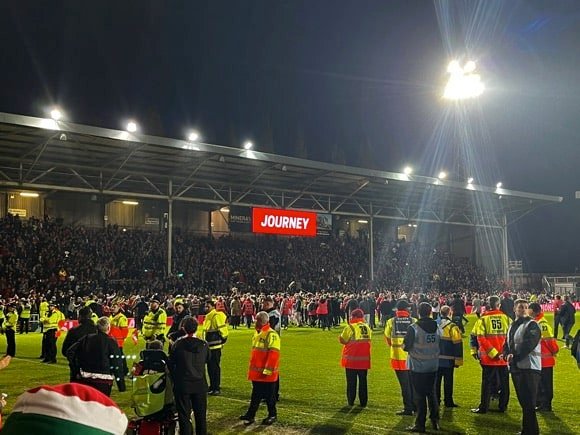
The figurehead striker had come back from a horrific injury on a Stateside tour in pre-season, notching another two-dozen goals to top the scoring charts, but Mullin strangely failed to rise to the challenge of League One and faded away while only 30, to be loaned out to Wigan.
With the Racecourse Ground now accommodating 13,000-plus and a fourth docu-series, Wrexham relied on momentum, strength in depth and a ten-game unbeaten run at the end to gain an improbable third straight promotion from League One to the second tier, a status the Dragons last enjoyed back in 1982. Wrexham now stood, in theory at least, one season away from the Premier League.
Bringing bags of international experience banging in vital goals for Wales, lanky striker Kieffer Moore proved his worth by hitting a classic hat-trick in the transformative 3-2 win over Championship leaders Coventry, proof that Wrexham could live with and beat the very best in one of the world’s toughest leagues.
Looking ahead to the return game in the penultimate round of the season, followed by a home game with probable title favourites Middlesbrough, Wrexham were preparing for the big time by welcoming a £18 million grant from the Welsh government to renovate the Racecourse Ground – and by accepting a minority stake from US hedge fund, Apollo Sports Capital.
While somewhat tarnishing the fairy tale, the funds should provide the wherewithal to lift Wrexham to the next level – and allow Rob and Ryan to take their seats in the best VIP boxes in the land before the decade is out. No-one can say they haven’t deserved it.
GROUND Guide
The field of dreams – and the story behind it
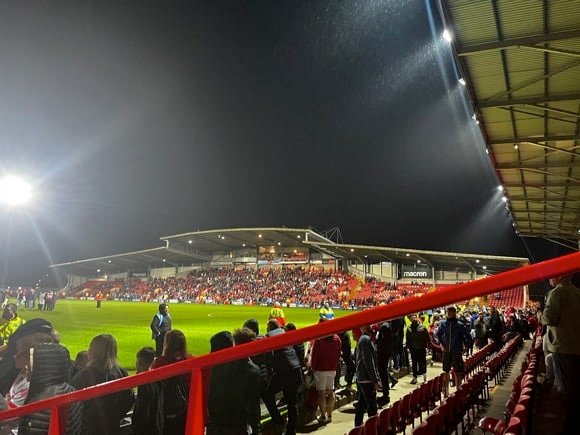
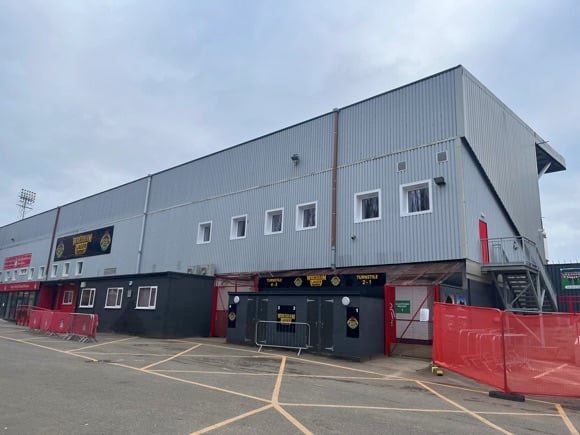
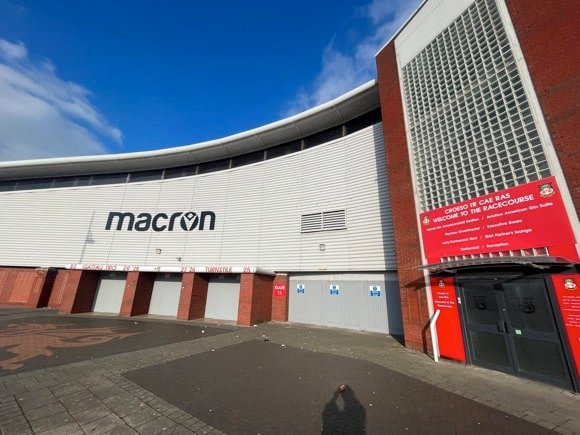
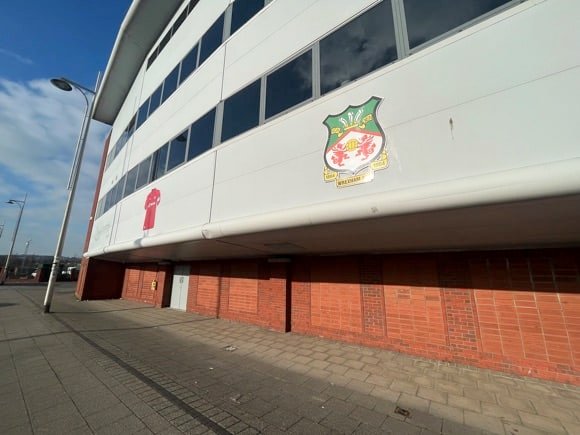
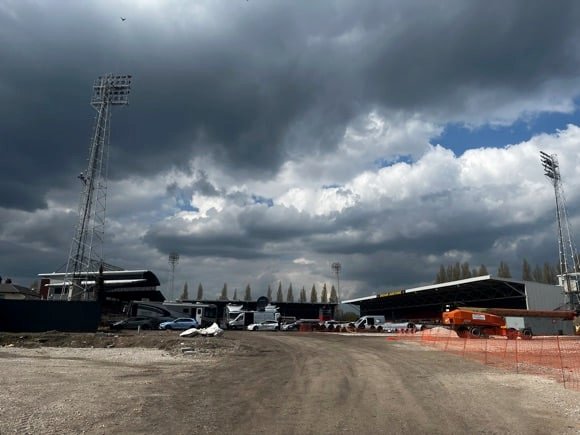
Steeped in charm and history, the Racecourse Ground is very much looking to the future, building a Kop Stand to fill the gap where a home end used to be. Originally set to hold 5,500, it is now slated to accommodate 7,750, raising the overall capacity of the Racecourse Ground to 18,000.
For the Euro U-19s staged in Wales in the summer of 2026, the Racecourse Ground is by far the largest ground – but capacity is just over 13,000. The Kop Stand is due for completion in early 2027 and will also house the dressing rooms. The pitch, relaid in 2025 at a cost of more than £1.5 million, will move a couple of yards towards the new home end.
Integral to the plan is for the national team to play more games here. The world’s oldest international stadium still in use is still the ground where Wales have played the most home games even though matches in modern times have been few and far between.
A friendly with Trinidad & Tobago here in 2019, a first since 2008, pointed to a further and more regular role for the Racecourse Ground – a fundamental reason for the controversial £18 million non-repayable grant from the Welsh government confirmed towards the end of 2025.
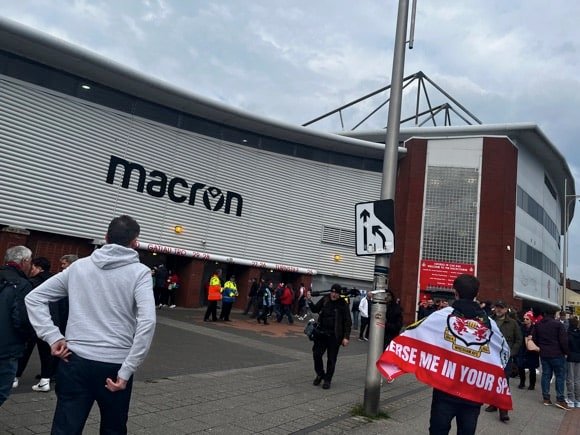
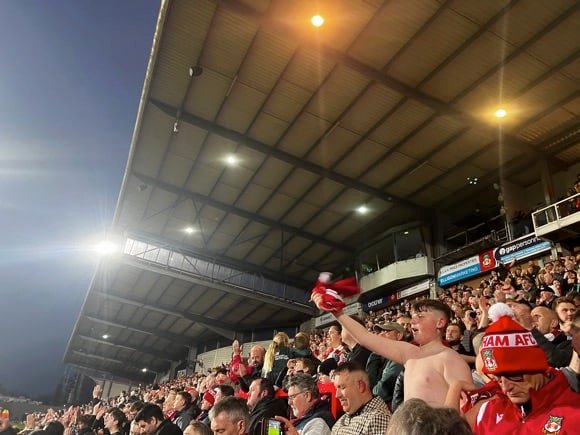
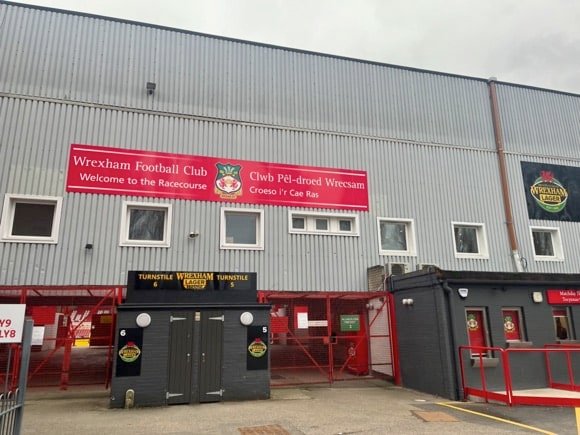
As its name suggests, and that of the Turf Hotel alongside, the site was originally used for horse racing, as early as 1807. The tavern was where Wrexham Cricket Club first convened to agree on a winter sport, and players later changed. Early games took place on the grassy patch alongside. As it was also used for cricket, the surface was reasonably smooth.
Wales played their first home game here in 1877 but it wasn’t until 1890 that a proper stand was installed, along the Mold Road side nearest the Turf Hotel, with seating added in 1913. From the 1920s, roofs covered the Plas Coch end – now the Glynwyr University Stand, aka Tech End – and the northern side facing Mold Road.
By the time the club was established in the Third Division North and attendances rose in the post-war boom, concrete terracing allowed the home end to welcome more than 9,000 of Wrexham’s most passionate supporters, turning the Kop into the stuff of legend.
A record 34,445 crowded in the ground for the visit of the Busby Babes in 1957. With floodlights erected two years later, the European nights of the 1970s and 1980s were fiery affairs, even for the likes of Hajduk Split, Porto and Roma.
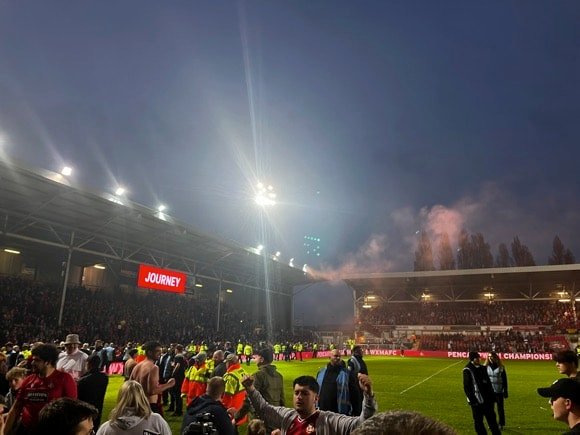
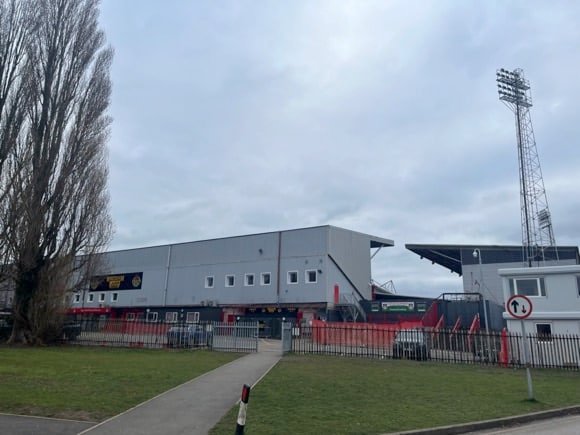
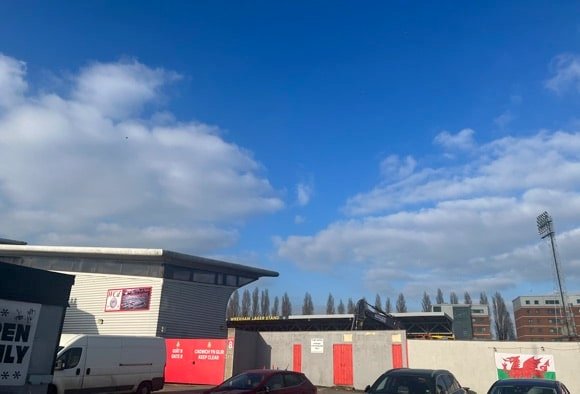
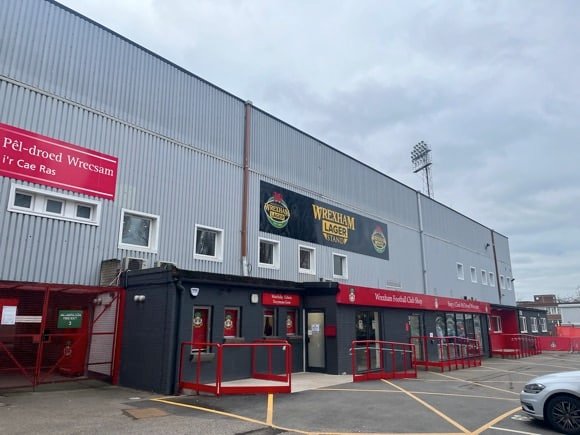
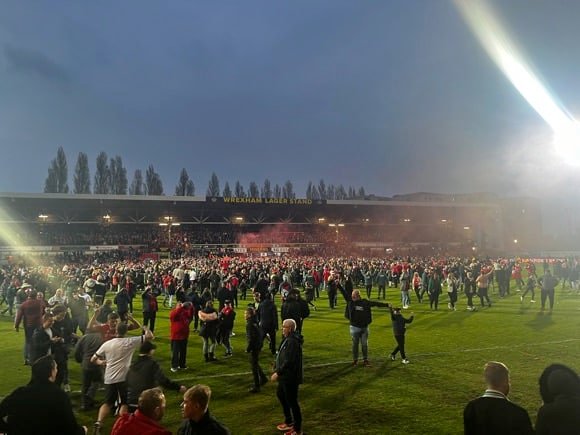
Regular visits by prestigious international opponents and promotion to Division Two initiated the construction of what is now the Wrexham Lager Stand, aka Yale Stand, after the college that once stood here. Away fans are allocated its upper (and sometimes lower) sections, through gates 1-4.
Following the closure of the Kop in 2008 for safety reasons, as well as Wrexham’s descent to non-league football, home fans were shifted to the opposite Tech End, which gained the sponsor’s name of the STöK Cold Brew Coffee Stand in 2023. The Colorado brewmeisters also assumed sponsorship of the ground as a whole, now officially called STōK Cae Ras.
A temporary Kop was also put in place that same year, raising capacity to 13,341. Of this, Mold Road, aka the Macron Stand, holds an all-seated 3,500 as well as private boxes.
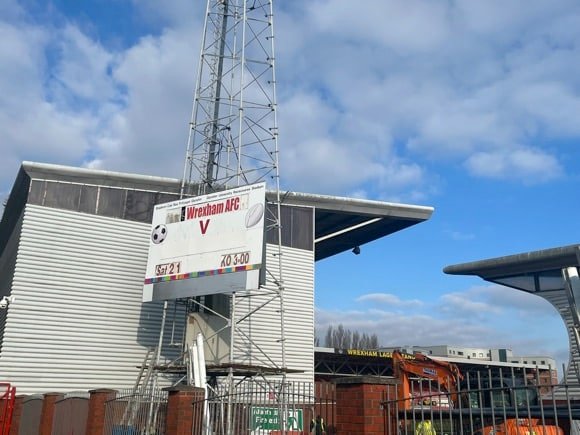
All of these improvements, and the revival of the Kop, would not have been possible without a change of ownership, of course. As part of the justifiably maligned ownership of Alex Hamilton in the early 2000s, he acquired the freehold rights to the ground, spiked the rent from the nominal annual £1 charged by his benign predecessor Pryce Griffiths to £30,000 a year. Worse, one of his companies could evict the club with 12 months’ notice.
Thankfully, the courts saw things differently, declared Hamilton’s transfer illegal, and the ground was taken over by a holding company, Wrexham Village. A decade later, ownership then passed to Wrexham University, who sold the freehold rights to the proprietors from across the Atlantic in 2022.
Improvements had already been made to the infrastructure before the Americans came in, which is why Wales graced the Racecourse Ground after a long hiatus, and several rugby league internationals were hosted here from 2010 onwards.
getting here
Going to the ground – tips and timings


Wrexham General station is on the north-western edge of the city centre, a short walk from the ground just over the railway lines. Turn right at the main road and you’ll see the stadium ahead. Wrexham Central is right in town, a 15min walk from the ground.
Nearly all services from London Euston require a change at Chester (overall journey time around 3hrs), sometimes also at Crewe. From Manchester Victoria/Piccadilly (overall journey time around 1hr 30mins), change at Chester, too. From Liverpool Lime Street, change at Chester or Bidston (overall journey time around 1hr 15-30mins), from Birmingham International or New Street, change at Shrewsbury or wait for the next direct service, journey time 1hr 40mins-2hrs.
The sat nav code for the STōK Cae Ras is LL11 2AH. A limited number of parking spaces (£12/car) is available at Wrexham University car park (LL11 2AW) behind the STöK Cold Brew Coffee Stand, overseen by The Big Parking. Booklng s recommended. Note there is no parking at Wrexham General station on match days.
Most parking options in town are beyond Wrexham Central station and a good 20min walk away. Guests staying at the nearby Premier Inn can park on-site for £7/24hrs, and there’s also pay-for on-site parking at the Ramada Plaza by Wyndham Wrexham.
getting in
Buying tickets – when, where, how and how much
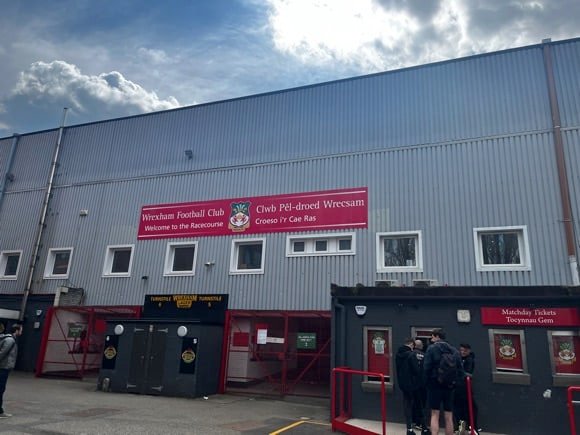
With the Kop Stand out of commission until early 2027 and capacity under 14,000, the few available tickets in the Wrexham Lager Stand (£26, over-65s/18-21s £21, 14-18s £14, under-14s £10) and STöK Cold Brew Coffee Stand (£24/£19/£13/£10) are allocated by ballot only, unless you invest in hospitality.
To throw your hat in the ring, you have to be a member – either a Digital Dragon (£25/under-18s £15), a Red Dragon (£35/£25) or a Gold Dragon (£50/£40). All give access to priority tickets (one per member) and the club’s ticket-exchange programme.
Hospitality packages begin with the Dugout Club (£90), the Executive Club (£120) and the Bamfords Suite (£150) and include your match ticket.
what to buy
Shirts, kits, merchandise and gifts
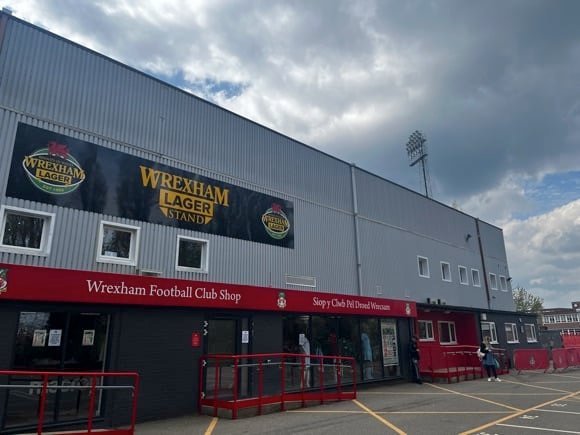
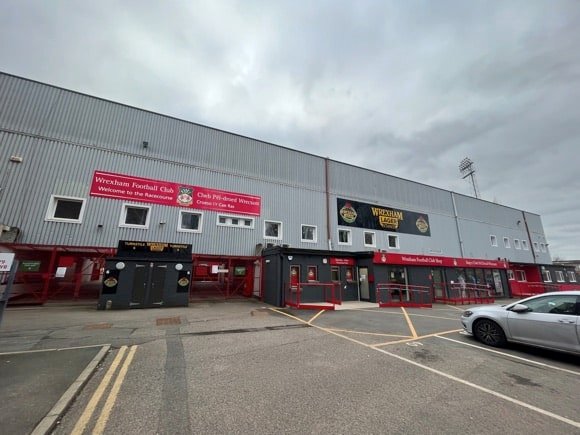
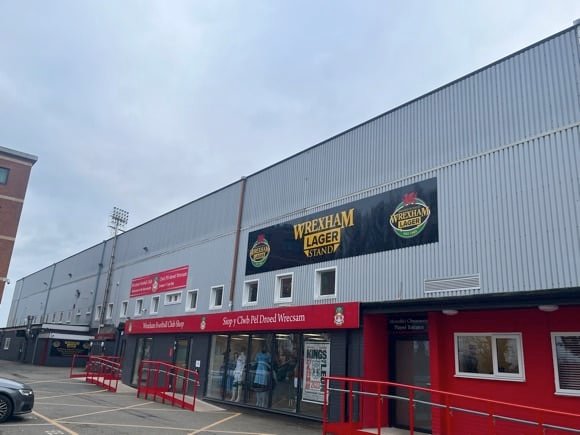
Wrexham’s club shop (Mon-Sat 9am-5pm, Sun 11am-4pm, match days 9am-kick off, then 30mins after the final whistle) is located behind the Wrexham Lager Stand, accessed through the car park.
Sponsored (and logo-branded) by United Airlines with the club badge centred, the current home shirt echoes the classic design of the early 1980s, fire red with a white V-neck fold-over collar and cuffs. Note the design feature in the lower hem, an etching of the Gresford Colliery with the number 266 to honour the lives lost in the mining disaster of 1934.
Both the second and third kits have the same United branding but with the club badge top right. Change strip is yellow with green pinstripes and the first words of the Welsh anthem ‘HEN WLAD FY NHADAU – LAND OF MY FATHERS’ running along the hem, the third-choice inspired by the connection with Patagonia in Argentina, whose many Welsh settlers formed the community of Y Wladfa under these colours of sky blue and white. Its message reads ‘DON’T FORGET WHERE YOU COME FROM’. The season of its launch, 2025-26, marked 160 years of Welsh-speaking colonists setting up along the Argentine coast in 1865.
The merch team is quick to capitalise on recent events – soon after the goalkeeper’s saves in the penalty shoot-out against Nottingham Forest in the FA Cup in January 2026, ‘King Arthur Okonkwo’ T-shirts were being knocked out. Fans of any sex are happy to wear the ‘Ollie Rathbone, Have My Children’ red number while illustrator Ralph Steadman of Hunter S Thompson fame created the punky ‘Wrexham AFC Est 1864’ top, perhaps inspired by the horrors he suffered at secondary school in nearby Abergele.
More unusual gifts include a dippy-egg board, a branded baking set and a defiant garden gnome.
Where to Drink
Pre-match beers for fans and casual visitors
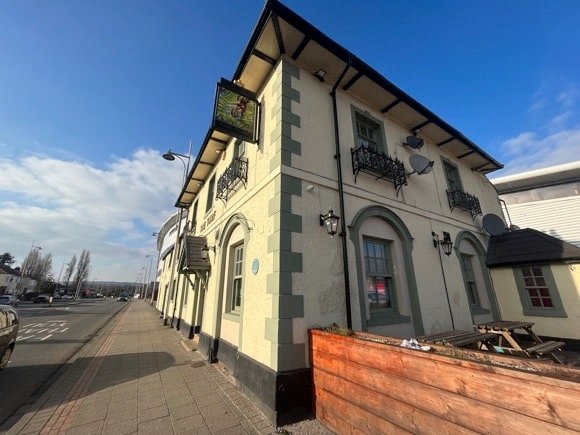
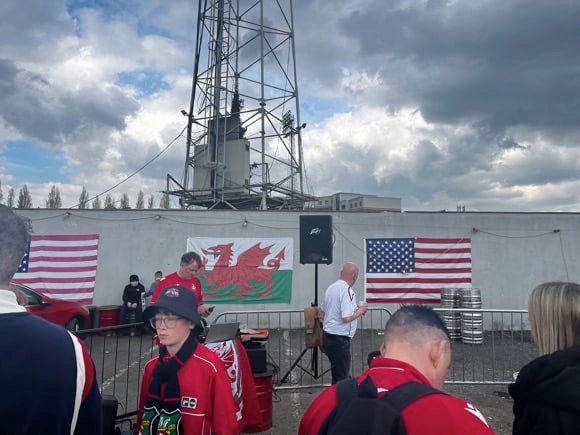
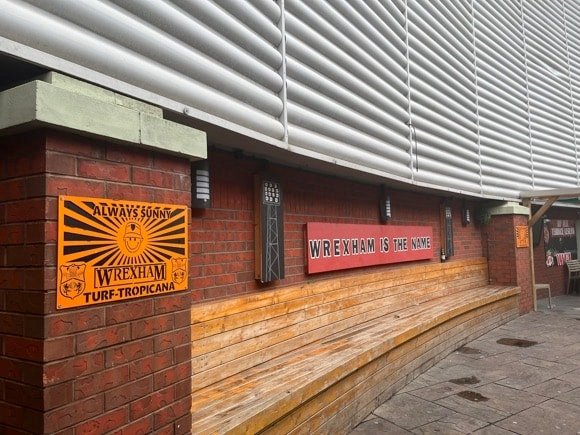
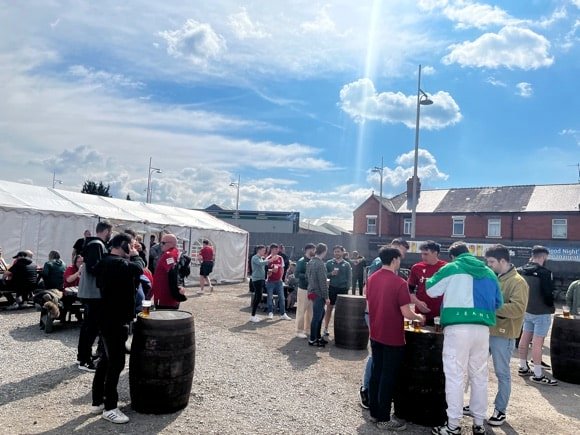
The longest-standing sport-focused pub in the UK – indeed, the world – The Turf has seen its star rise along with the team that has played next door since 1864. Thought to have opened during the Napoleonic era around the late 1700s and early 1800s, the Turf Tavern initially catered to the horse-racing fraternity who witnessed a contest here in 1807, according to the earliest records. By the mid-1800s, racegoers could observe their horse come in over the finish line from a separate VIP area.
Two years after local cricketers convened here in 1864 to agree on a winter team sport to take up, and by doing so forming today’s Wrexham AFC, the two parts of this facility became one as the Turf Hotel.
Overhauled in 1913, this pub was still where players changed until the mid-1900s. Synonymous with the Racecourse Ground and Wrexham AFC, the Turf became integral to the match-day experience for home and away supporters, not least after a car park was added in the 1960s.
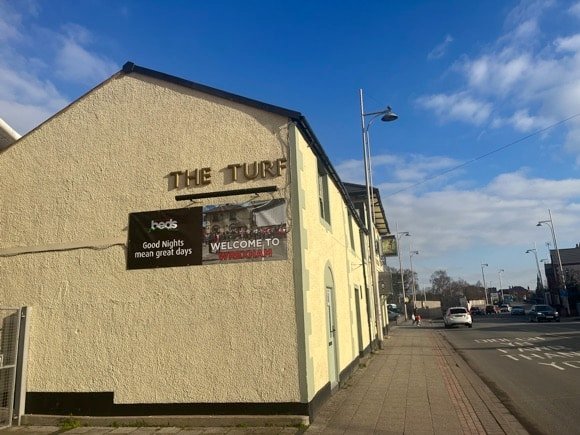
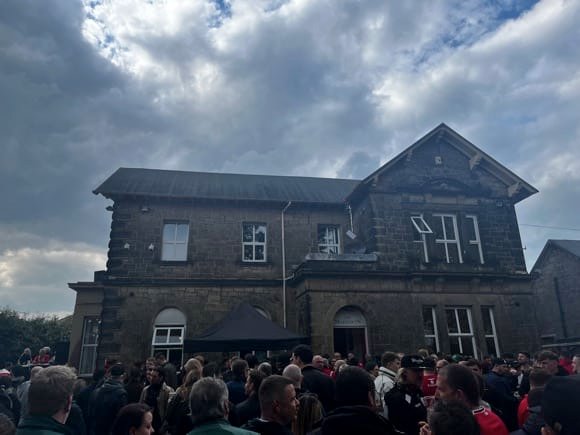
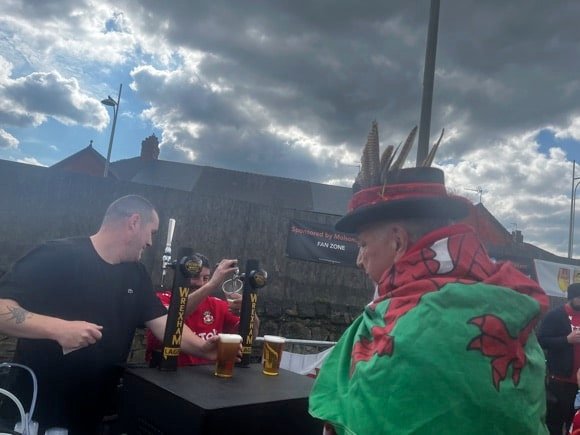
During the grim days of the early 2000s, when the future of Wrexham AFC and the Racecourse Ground was at stake, so was this pub’s – it took the First Minister of Wales, the most senior politician in the land, to step in and prevent such stupidity. The pub was even chosen as the starting point for Day 12 of the 70-strong section of torch relay routes around the UK in the run-up to the 2012 Olympics.
One of many leading characters in the club’s revival as presented in the docu-series Welcome to Wrexham, landlord Wayne Jones picked up the reins in recent times, his parents regulars back in the day.
This was way before Hollywood came knocking and various celebs rocked up to knock back pre-match pints of Wrexham Lager in the spacious beer garden, now a Fan Zone set up a couple of hours before kick-off. Those without a ticket can gather here to see the game screened in a real match-day atmosphere – ‘where Saturday finds its volume’ – but be warned. Such is the popularity of The Turf these days that it’s single-file entry into the pub.
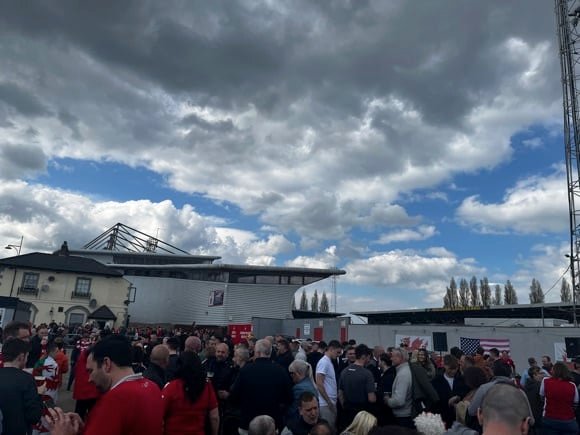
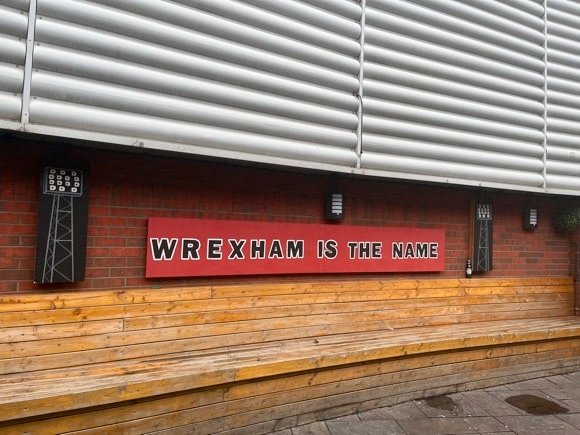
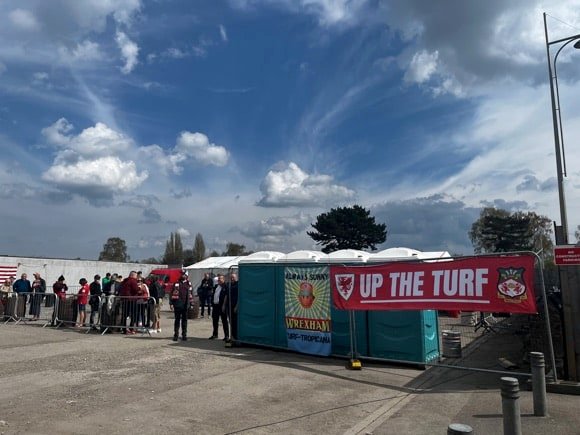
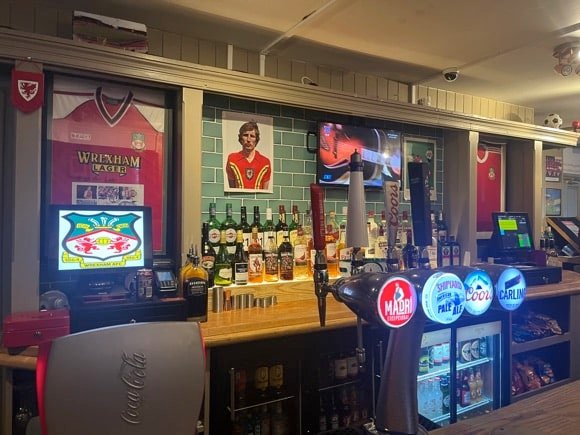
Though there’s little chance of Wrexham playing age-old rivals Chester any time soon, more raucous away fans may be better advised to drink elsewhere. If you’re here for the duration, there’s also Madrí, Magners and Guinness on draught, Coors for colonials and Neck Oil IPA for connoisseurs.
Laughably affordable breakfasts, lunchtime burgers and meal deals are served most of the week, the match-day menu comprising burgers, hot dogs and chips, with curry sauce or gravy. The same is served in the butty van outside.
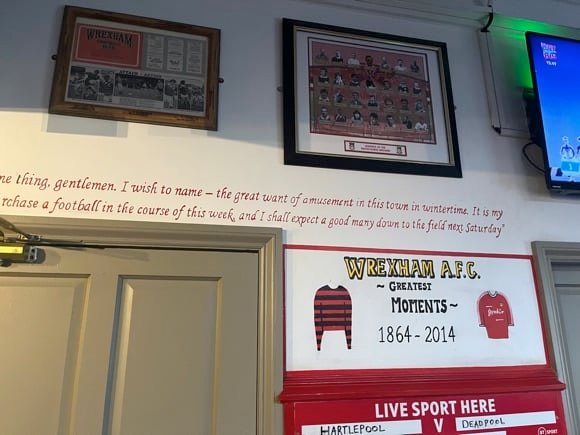
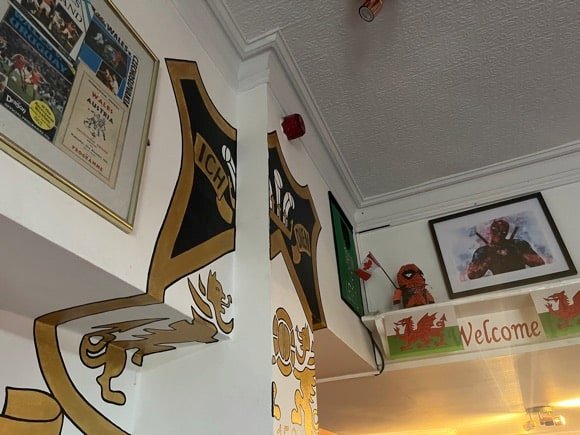
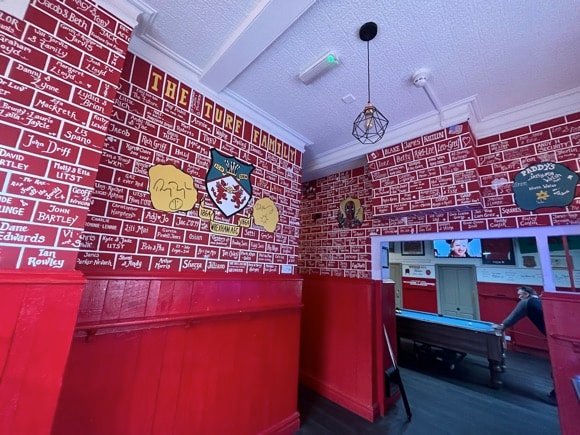
Within, a pictorial history of Wrexham AFC is offset by a pool table, and a wall of fame of fans and regulars, each with their own signed tile: The Turf Family.
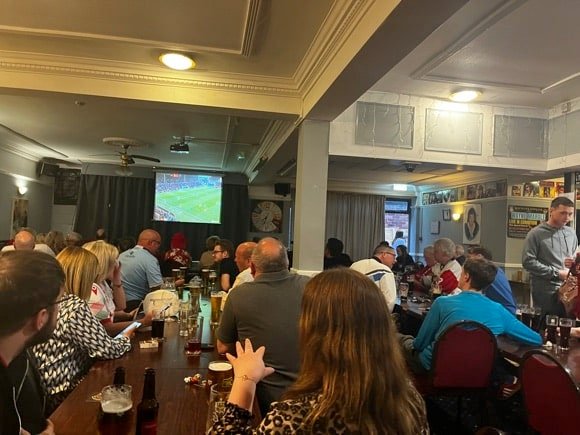
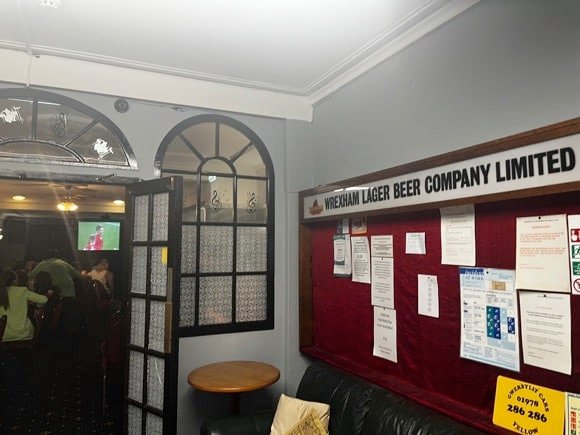

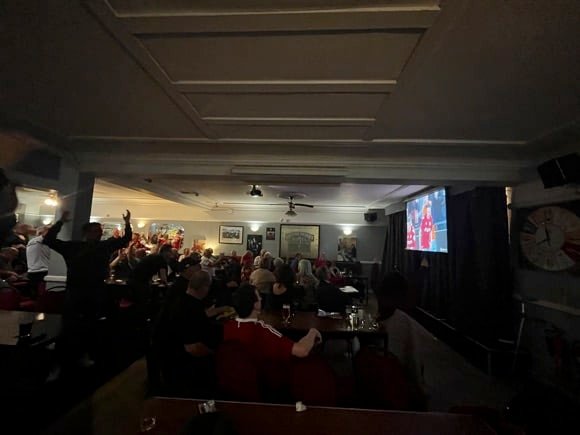
Further up Mold Road, an alternative to The Turf is Maesgwyn Hall, an events space open on match days showing Sky Sports, pulling pints and serving food in friendly surroundings. Look out for their celebrity dinners starring popular figures from the pre-internet era, recent examples include Bryan Robson and Bruce Grobbelaar.
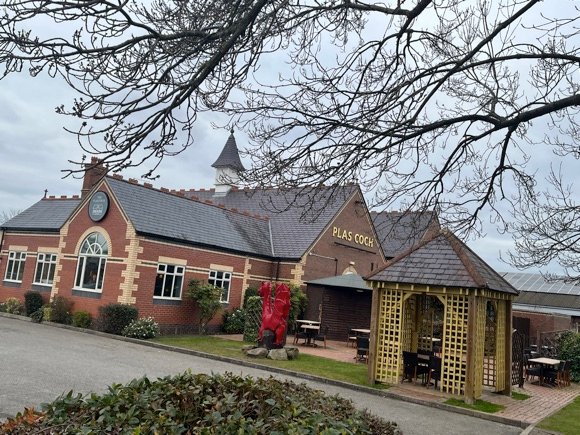
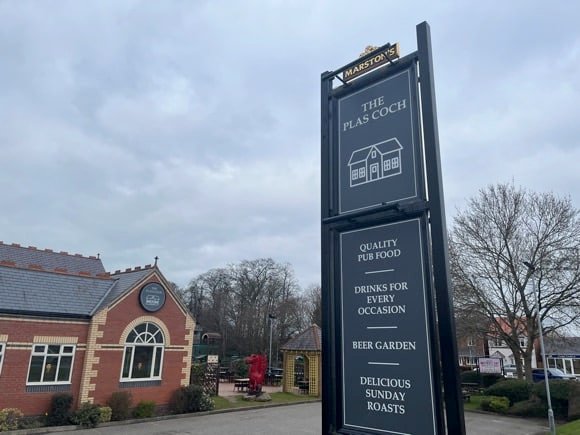
If you have kids in tow, Plas Coch in the retail park of the same name behind the STöK Cold Brew Coffee Stand serves family-friendly fare with meal and drinks deals thrown in. Draught options are dominated by cider, either fruit-flavoured Old Mout or Bulmers.
Once you’re inside the ground, Wrexham Lager is served from Jonesy’s Bar in the STöK Cold Brew Coffee Stand. Visiting supporters can also buy refreshments behind the Wrexham Lager Stand – but no alcohol.